Your reputation is an asset. Make sure the next person at the dealership can see why it matters.
Imagine the manager at your largest dealership account leaves. You have worked together for years. They know your installers, trust your turnaround, and understand what your shop can do.
The replacement knows none of that.
Your workmanship has not changed. Your relationship with the person who sends the work has.
Could the new manager quickly understand why the dealership uses you? Could your team show what you offer, introduce the right people, and follow up? Or would years of trust have to be rebuilt through a single conversation?
That is a marketing question—even if your business has never relied heavily on advertising.
You have been marketing for years
Every dealership visit, product demonstration, referral, and conversation about your workmanship has helped win business. So has the salesperson who remembers to stop by and the driver who represents your shop well during a pickup.
You may have spent little on ads. You have still invested time, payroll, and effort in earning trust.
A useful marketing plan should respect that work. Its job is not to replace relationships with software or tell an established owner that everything they have done is outdated.
Its job is to make those relationships easier to maintain, support, and extend.
Your dealership knows you. Does everyone inside the dealership know you?
One manager may understand your capabilities. A new salesperson may know only one of the products you install. The used-car team may not realize you offer interior upgrades. Someone handling commercial customers may never think to ask about your upfitting work.
It is easy to say, “That dealership already knows us.” It is more useful to ask who knows you, what they know, and who is missing from the conversation.
Consider a salesperson discussing leather interiors with a buyer. Can that salesperson show useful installation examples, explain the next step, and reach someone at your shop? Or does the conversation stop at “I think we have a guy who does that”?
Clear product information, authentic photos, and a reliable contact path support the relationship you already earned. They give more people inside the dealership a way to act on it.
Run a dealer-relationship check
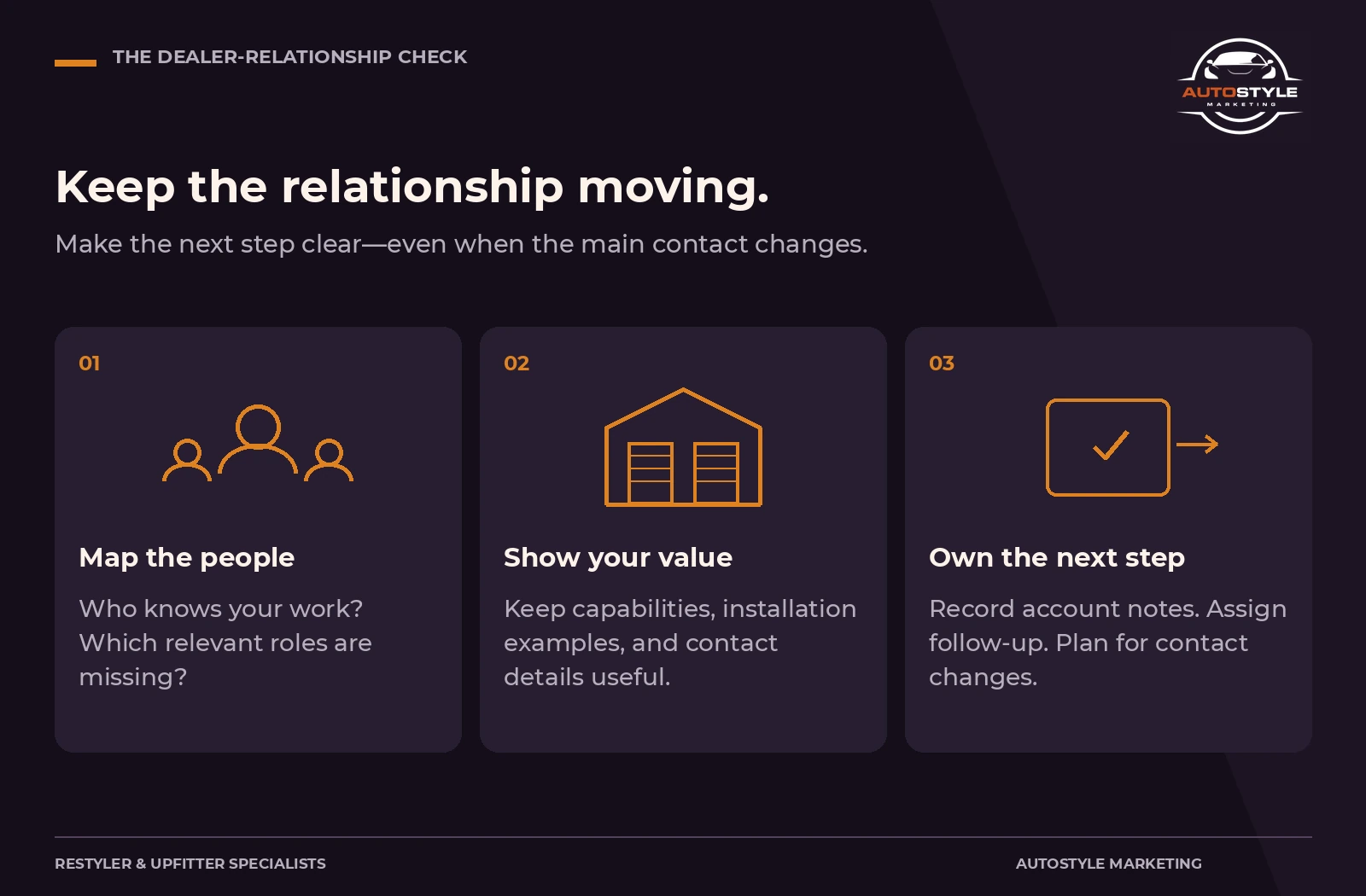
Choose the accounts that matter most to your business. For each, answer these questions:
- How much of our work depends on this account? Use your own records rather than a guess.
- Which people there know us, and which relevant roles do we still need to meet?
- Who on our side owns the relationship and the next follow-up?
- Where are the account's preferences, open estimates, and recent conversations recorded?
- What would a new contact learn from our website and sales materials?
- If our main contact left, what would we do first—and who would do it?
This is not a risk score with a universal passing number. It is a way to identify dependence on one person, information that exists only in someone's memory, or opportunities that no one clearly owns.
You do not need a larger ad budget to start answering those questions.
Make it easier to introduce your business again
If the check exposes a weak point, start with a useful correction.
Update the page that explains your dealership services. Gather permission-cleared photos of relevant installations. Give your salesperson a concise way to explain what you offer and how to request help. Record the contacts and next steps in a system the right people can access.
Then assign ownership. Who supplies current product information? Who keeps account notes useful? Who follows up on an estimate? Who notices when a contact changes roles?
A customer relationship management (CRM) system can help organize that work. It does not automatically create a good relationship or replace the person responsible for the next conversation. Any automated follow-up also needs an appropriate audience, consent where required, and a clear reason to send it.
A full schedule is not the whole picture
Being busy is good. It does not answer every growth question.
Are the jobs a good fit for your installers and margins? Are you replacing relationships as people move on? Does demand become thin in certain periods? Are you receiving inquiries that never become estimates—or estimates that never receive a follow-up?
If your bays are full, the next priority may not be more leads. It may be a healthier mix of work, better conversion of existing opportunities, or a more deliberate way to maintain key accounts.
That is why business goals and capacity should guide the marketing plan rather than the number of ads an agency wants to run.
Broaden your options without abandoning dealerships
A relationship check may reveal room to deepen your dealership work. It may also raise questions about other buyers.
Could retail customers support a service your dealerships rarely sell? Could your upfitting skills help a suitable commercial customer? Would better communication help existing accounts better understand your capabilities?
Those are options to evaluate—not instructions to chase every channel at once. Retail, dealership, and fleet work have different buyers and requirements. Choose opportunities that fit your business and your ability to deliver.
Ask a marketing partner what it would fix first
You should question the investment. Before you hire anyone, ask:
- What problem are we addressing first, and what evidence supports that choice?
- What work will you deliver, and what must our team contribute?
- What are the complete costs?
- How will we judge progress and decide what changes next?
For a dealership-focused plan, useful measures might include meaningful account conversations, open estimates with a clear next step, new contacts in relevant roles, or sales tied to documented activity where tracking permits.
Reports should help you decide what to do—not simply prove that an agency stayed busy.
Protect what you built, then build on it
AutoStyle Marketing is a growth partner for established restylers and upfitters, typically generating $1 million to $50 million in annual revenue. Our Strategy First approach connects business goals, customers, offers, and priorities before tactics take over.
For an established shop, that means respecting the relationships and workmanship that underpin your reputation while identifying where they need support.
Start with the dealer-relationship check. If it exposes gaps, talk with AutoStyle Marketing about the business problem you want to address. The first conversation does not have to begin with “we need more ads.” It can begin with “We have built something valuable, and we want a stronger way to carry it forward.”