
Your campaign report shows inquiries. Your shop schedule still has openings. Should you change the ads, spend more, or give the campaign more time?
Start by finding out what happened between the inquiry and the booking. A poor-fit request, an unanswered call, and an estimate that never reached the customer are different problems. Calling all three “bad leads” makes the next marketing decision a guess.
In our webinar on retail, dealership, and fleet sales, Maham Fatima described reviewing both the phone conversation and what happened afterward in the CRM. Jesse Stoddard emphasized choosing a practical measure and reviewing it regularly. Those ideas have an important marketing application: evaluate the whole path before deciding whether a campaign deserves more budget.
Here is a manageable audit you can use with your marketing partner and the person responsible for incoming inquiries. It is a way to investigate, not a formula that promises more sales.
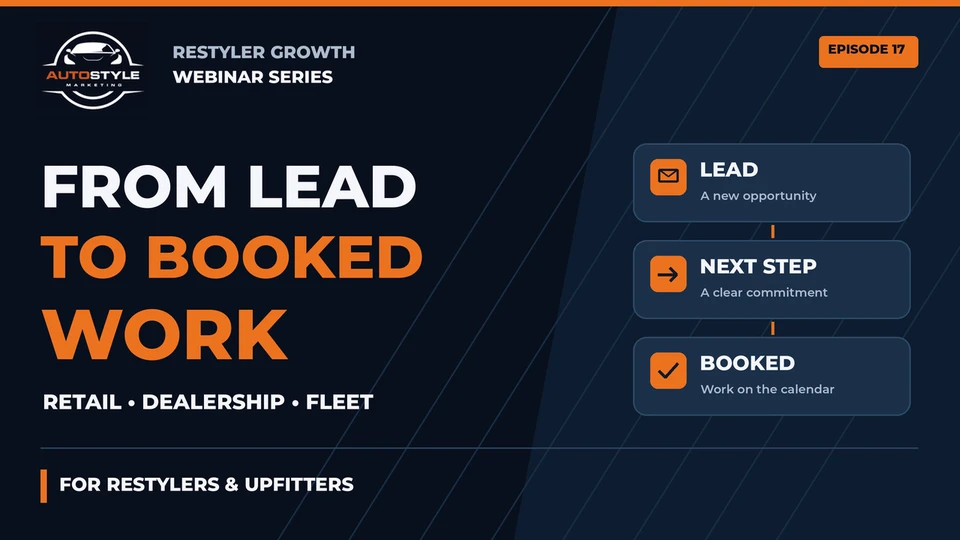
Watch the Webinar 17 conversation.
1. Choose a small group you can actually trace
Pick one service, one campaign or source, and a defined inquiry date range. Review ten recent inquiries if that gives you a manageable starting point. Include unsuccessful and still-open opportunities, not just the wins. If fewer than ten exist, review what you have and keep the limitation visible.
Use one record per buying opportunity. A form submission and a follow-up call from the same person about the same job should not automatically become two new leads. Separate spam, vendor calls, and existing-job status questions from new-work inquiries, but retain those counts so you can spot tracking problems.
Do not combine a retail tint campaign and a fleet-upfit campaign into one verdict. Their buyers, project sizes, and decision timelines may differ. This small review is for finding fixable gaps, not declaring a statistically proven winner.
2. Check the promise the customer saw
Open the actual ad, listing, or referral page and follow its route to the landing page and contact option. Then compare that experience with the inquiry. What did the customer expect to receive, and was that expectation reasonable?
- Service fit: Does the campaign clearly describe work your shop performs?
- Location and vehicle fit: Can the customer tell where you work and which vehicles or applications the offer covers?
- Offer clarity: Does the page explain what is included, what needs an assessment, and what happens after someone contacts you?
- Continuity: Does the form or call reach someone who knows the offer and can see the information already provided?
For example, imagine a paint-protection-film ad showing a full vehicle while the landing page describes only front-end coverage. If callers repeatedly expect the larger package, investigate the message before labeling them price shoppers. This is an illustrative scenario, not a reported customer result.
Correct the specific mismatch. That may mean a clearer coverage image, a more precise headline, or a better handoff of form details. A bigger budget would not answer that question.
3. Separate customer fit from follow-through
For each inquiry, answer two questions separately: was this a plausible customer for the advertised service, and did the shop complete the next action it agreed to take? A person you never reached is not automatically a poor-fit lead. Mark fit as unknown until you have enough information.
Use the call notes or a lawfully obtained recording, the message history, and the CRM record together. An automated acknowledgment shows receipt; it does not prove that someone answered the customer’s question. A task marked complete is useful, but verify that the promised estimate or reply actually went out.
A copyable inquiry-review checklist
- Source and promise: Where did the inquiry come from, which offer did the buyer see, and is that source known or uncertain?
- Customer need and fit: What work did they request? Record fit, poor fit with a reason, or unknown.
- Response: When did the inquiry arrive, when did a person first respond, and was there a two-way conversation?
- Commitment: What was promised, who owned it, and when was it due?
- Evidence and status: Was that action completed? Is the opportunity booked, lost with a stated reason, still open, or not yet understood?
- Next correction: Is the evidence pointing to the campaign, the page, the handoff, shop capacity, or a gap in the records?
Keep customer contact details and recordings in approved internal systems. Use anonymized examples in broader reporting. If an AI summary helps you review calls, check the underlying conversation before treating its interpretation as a fact.
4. Give marketing a reason, not just a lost status
“Lost” is an outcome label, not an explanation. The useful feedback is what prevented the next step. Record the customer’s stated reason separately from your team’s interpretation, and do not invent a reason when the record is incomplete.
- Wrong service or location: Check targeting, search terms where available, and the page’s wording.
- Expected something different: Compare the ad, images, offer details, and landing page.
- No successful contact: Review response attempts and contact information before concluding that the audience is wrong.
- Estimate or answer not delivered: Repair ownership and follow-through before using that inquiry to judge campaign quality.
- Shop could not meet the required timing: Review capacity and advertised expectations. A suitable customer can still be a poor match for this week’s schedule.
- Still considering or awaiting approval: Keep the opportunity open with its next action. Do not force it into a lost category just to finish a monthly report.
Recurring questions can also become useful website content. If buyers repeatedly ask whether a service covers a particular area of the vehicle, explain it with an accurate photo or diagram. If they ask what to bring to an assessment, add that answer near the appointment step. Use real questions to make the next inquiry better informed.
5. Read the results without mixing the time periods
For the group you selected, count valid new-work inquiries, those reached in a two-way conversation, those confirmed to fit, and those booked. Keep open and unknown records visible. If you report a percentage, name the numerator and denominator so everyone knows what it measures.
Separate inquiries received during a period from work booked during that period. A booking this month may have started with an inquiry last month. Track the selected group forward, allowing for its decision timeline, rather than dividing this month’s bookings by this month’s inquiries and assuming they belong together.
Treat source attribution with similar care. A customer may see your work on social media, search your shop name later, and then call. A recorded source is useful evidence, not proof that one channel did all the work. Keep the customer’s reported discovery path alongside the tracked source where available.
Booked work is not the same as completed, paid work. When evaluating financial return, reconcile the outcome with your actual job and payment records rather than treating every opportunity value as revenue.
6. Leave the review with one change and one owner
Bring a few actual inquiry records to the review, including an unresolved one. Ask your marketing partner and the shop’s intake lead to agree on the clearest gap, the correction, who owns it, and when to check again.
If the message is unclear, revise that message. If inquiries are being missed, repair the routing. If promises are not being completed, fix ownership. Watch the measure tied to that change, such as whether the promised responses were delivered, rather than changing several things and crediting whichever one looks best.
You may still decide to change a campaign or increase its budget. The difference is that you will be making the decision with evidence about where the process is working and where it is not.
Connect your marketing to what happens in the shop
AutoStyle Marketing connects strategy, websites, visibility, and follow-up for restylers and upfitters. If your reports and your shop schedule seem to be telling different stories, let’s talk about your shop and the path your inquiries take.
Book a discovery call with AutoStyle Marketing.
For the customer-conversation side of the process, read the companion AutoStyle Sales playbook. It covers discovery, recommendations, and next steps across retail, dealership, and fleet sales.